
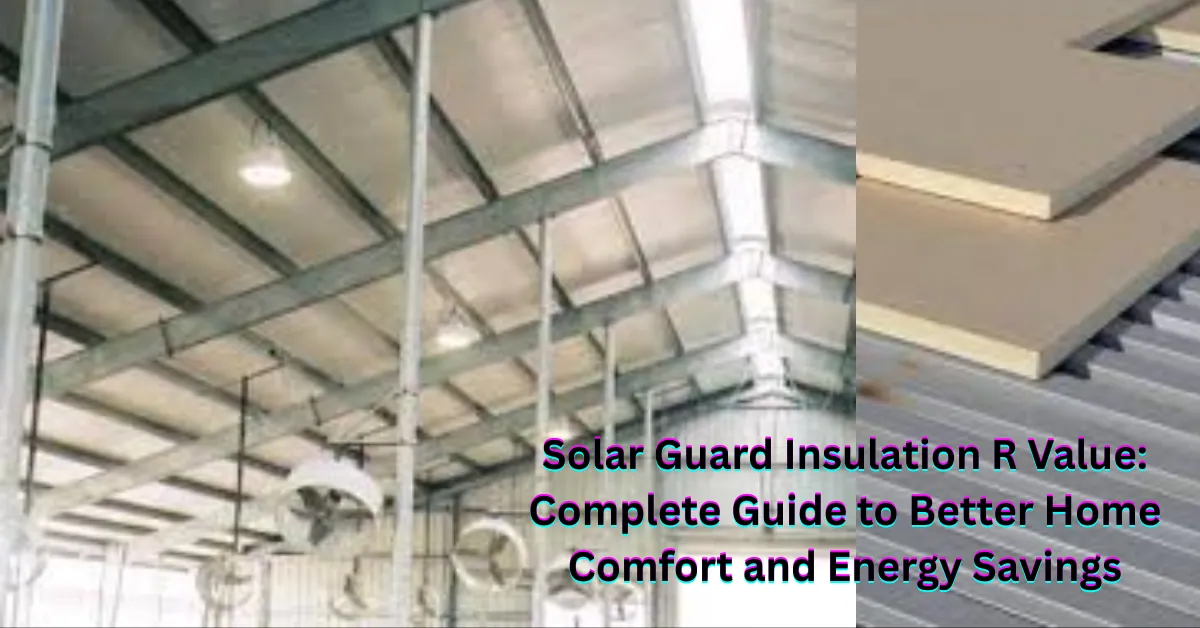
Solar Guard Insulation R Value: A Comprehensive Guide to Increased Comfort and Energy Savings in Your Home.
Insulation is frequently the first thing that comes to mind when homeowners search for ways to lower energy costs and enhance indoor comfort. Solar Guard Insulation has drawn interest among the various insulation products on the market today due to its capacity to reflect heat and enhance energy efficiency. But a common query from homeowners is, “What is the R-value of Solar Guard Insulation?”
Prior to making any home improvement investments, it is crucial to comprehend insulation efficacy. We’ll go over Solar Guard Insulation in this article, including how it functions, its R-value, advantages, installation issues, and whether it’s the best option for your home.
Solar Guard Insulation: What Is It?
By reflecting radiant heat away from a building, Solar Guard Insulation, a reflective insulation product, lowers heat transfer. Solar Guard mainly functions by reflecting radiant radiation, in contrast to conventional insulation materials like fibreglass, cellulose, or spray foam that slow down conductive heat transfer.
One of the main causes of heat accumulation in homes, particularly in the sweltering summer months, is radiant heat. A substantial amount of heat enters the attic space when sunlight hits a roof. By reflecting a significant portion of radiant energy before it reaches living spaces, Solar Guard insulation helps lower this heat gain.
The device is frequently put in metal buildings, garages, attics, roofs, walls, and warehouses where reducing heat gain is crucial. If you want to soundproofing your window then click here and read the post.
Comprehending R-Value in Insulation
It’s crucial to comprehend what R-value is before talking about Solar Guard’s R-value.
The resistance of an insulating substance to heat flow is measured by its R-value. A material’s ability to slow down heat transmission increases with its R-value.
For instance:
- R-values for fibreglass batts can range from R-13 to R-38.
- R-6 to R-7 per inch may be provided via spray foam insulation.
- Generally, cellulose insulation provides R-3.5 per inch.
Traditional insulation products rely on thickness and density to achieve higher R-values. Direct comparisons are more difficult because reflective insulation materials, like Solar Guard, function differently.
What Does Solar Guard Insulation’s R-Value Mean?
The product type, installation technique, and quantity of air space surrounding the reflecting surface are some of the variables that affect Solar Guard Insulation’s R-value.
Unlike fibreglass or foam insulation, reflective insulation products typically don’t have a set R-value. Rather, how well they reflect radiant heat determines how well they work.
Solar Guard reflective insulation can offer an efficient thermal performance that might greatly increase overall building efficiency when put properly with an air gap. By lowering radiant heat gain, the system may provide thermal benefits in some applications that are similar to greater standard insulation values.
Manufacturers frequently offer tested performance data instead of a single, universal R-value since installation conditions differ.
To understand expected performance in their particular environment and building design, homeowners should always check the product specifications and installation instructions.
The Operation of Solar Guard Insulation
Reflective technology is how Solar Guard insulation operates.
The reflective surface, which reflects radiant heat away from the building structure, is usually composed of highly reflective aluminium foil or a comparable material.
Three methods are used in the process:
First, a significant amount of incoming radiant heat is blocked by the reflective surface.
Second, by keeping solar heat from deeply penetrating the building shell, it lowers attic temperatures.
Third, it lessens the strain on heating and cooling systems by assisting in the maintenance of more consistent interior temperatures.
Because of this novel strategy, Solar Guard works particularly well in hot, sunny locations where radiant heat gain is a significant issue.
Why R-Value Is Not Enough to Tell the Whole Story
When assessing insulation goods, many homeowners just consider the R-value. R-value is significant, but it doesn’t necessarily provide all the information.
The main function of traditional insulation is to prevent conductive heat transmission. A significant amount of summertime heat gain can be attributed to radiant heat transmission, which is the focus of Solar Guard.
For instance, radiant heat from the roof can still cause an attic with ordinary insulation to get very hot. The quantity of radiant heat that enters the attic can be greatly decreased by installing a reflective insulation system.
As a result, even though the reflective insulation may not have a traditional R-value equal to thick fibreglass insulation, homeowners frequently enjoy reduced attic temperatures and increased comfort.
For optimal performance, many energy-efficient homes combine reflective and conventional insulation.
Solar Guard Insulation’s Advantages
The capacity of Solar Guard insulation to increase energy efficiency is one of its main benefits.
Homeowners may experience cheaper summer cooling expenses by minimising heat transfer via the roof attic. Maintaining appropriate inside temperatures requires less effort from air conditioning systems.
Enhanced indoor comfort is yet another significant advantage. During warmer weather, rooms stay cooler, minimising temperature swings throughout the house.
By lowering operating hours and total system strain, Solar Guard insulation can also help HVAC systems last longer.
Reflective insulation is also strong, lightweight, and impervious to moisture-related problems that some conventional insulation materials have.
Solar Guard insulation is a feasible update for existing homes because it can be placed without requiring significant structural alterations, which is appreciated by many homeowners.
Attic Solar Guard Insulation
One of the most popular places to install Solar Guards is in attics.
In certain places, summertime attic temperatures can reach 130°F (54°C). Air conditioners may have to run constantly as a result of the excessive heat radiating downward into dwelling areas.
Reducing heat accumulation and enhancing overall energy efficiency can be achieved by installing Solar Guard insulation in the attic.
Instead of letting radiant heat into the attic, the reflecting barrier reflects it back toward the roof.
After installation, many homeowners report more constant inside temperatures and a cooler attic environment.
Solar Protection for Metal Structures
Large amounts of solar heat can be absorbed by metal buildings, making cooling them uncomfortable and costly.
Typical applications for Solar Guard insulation include:
Metal storage facilities
Structures used for agriculture
Workshops
Facilities for storage
Commercial buildings
The reflecting surface enhances interior temperature regulation and lessens heat absorption.
This can save cooling expenses and provide a more comfortable working environment.
Is It Possible to Combine Solar Guard with Other Insulation?
Indeed. In actuality, the finest outcomes are frequently obtained by combining Solar Guard insulation with conventional insulation.
For instance, homeowners could put in:
Attic floors with fibreglass batts
Walls with spray foam insulation
Insulation made of cellulose in roof cavities
in addition to reflecting barriers from Solar Guard.
All three types of heat transport are addressed by this combination:
Convection, Conduction, and Radiation
As a result, the house becomes more pleasant and energy-efficient all year long.
Installation-Related Issues– solar guard insulation r value
The effectiveness of Solar Guard insulation depends heavily on proper installation.
For reflective insulation to work properly, there must be an air gap. Performance may be diminished if the reflecting surface is forced up against another material without any space between them.
Expert installers know how to arrange the material so that radiant heat reflection is maximised.
Important installation elements consist of:
Proper positioning
Sufficient air spaces
Appropriate sealing
Considerations for ventilation
adherence to regional building regulations
For optimal outcomes, homeowners should always adhere to manufacturer instructions.
Does Solar Guard Insulation Make Sense?
Solar Guard insulation is a valuable purchase for a lot of households.
The product has a number of benefits:
Reduced use of energy
Enhanced comfort indoors
Lower temperatures in the attic
Increased HVAC effectiveness
Durability with time
The biggest advantages are frequently observed in areas with hot weather and lots of sunlight.
Solar Guard can greatly improve an existing insulation system when applied properly, but it shouldn’t always be used in place of conventional insulation.
Upkeep and Durability
The longevity of reflective insulation systems is one of their benefits.
After installation, Solar Guard insulation usually requires very little upkeep.
When shielded from physical harm, reflecting barriers typically continue to function for many years, in contrast to some insulation materials that may eventually settle, compress, or absorb moisture.
Maintaining the material’s cleanliness and correct placement can be ensured with routine attic inspections.
Solar Guard insulation can continue to save energy for decades with the right installation and maintenance.
Common Myths Regarding Insulation for Solar Guards
The idea that reflective insulation functions just like fibreglass insulation is one prevalent misconception.
The two products actually function differently. Heat conduction is slowed by fibreglass, while radiant heat is reflected by Solar Guard.
The idea that reflective insulation replaces conventional insulation is another myth.
For best results, most energy experts advise mixing reflective insulation with traditional insulation. Additionally, some homeowners believe that reflective insulation is only effective in the summer. Although it works best to prevent heat gain in the summer, it can improve overall thermal efficiency all year long.
Selecting the Appropriate Insulation Approach
Every house is unique. The optimal insulation approach depends on a number of factors, including climate, roof design, attic ventilation, and current insulation levels.
Prior to putting in Solar Guard insulation, householders ought to assess:
Levels of current insulation
Bills for energy
Problems with indoor comfort
Climate circumstances
HVAC efficiency
Whether Solar Guard insulation is a good addition to the house can be ascertained with the aid of a professional energy evaluation.
In conclusion, Solar Guard Insulation R Value
An efficient reflective insulation option that lowers radiant heat transmission and boosts energy efficiency is Solar Guard Insulation. When put properly, its capacity to reflect radiant heat can greatly enhance building performance even if it does not necessarily have a conventional fixed R-value like fibreglass or spray foam insulation.
Solar Guard insulation can be a useful supplement to an overall insulation system for homes looking for reduced energy costs, more comfort, and better attic temperature control. It offers a thorough method of regulating heat transfer and producing a more comfortable living space when paired with conventional insulation materials.
Making the correct insulation investment now can result in years of energy savings, improved comfort, and a more functional home.
Do let us know how you feel about this information by commenting.
Like our Facebook page and follow for other updates like this.