
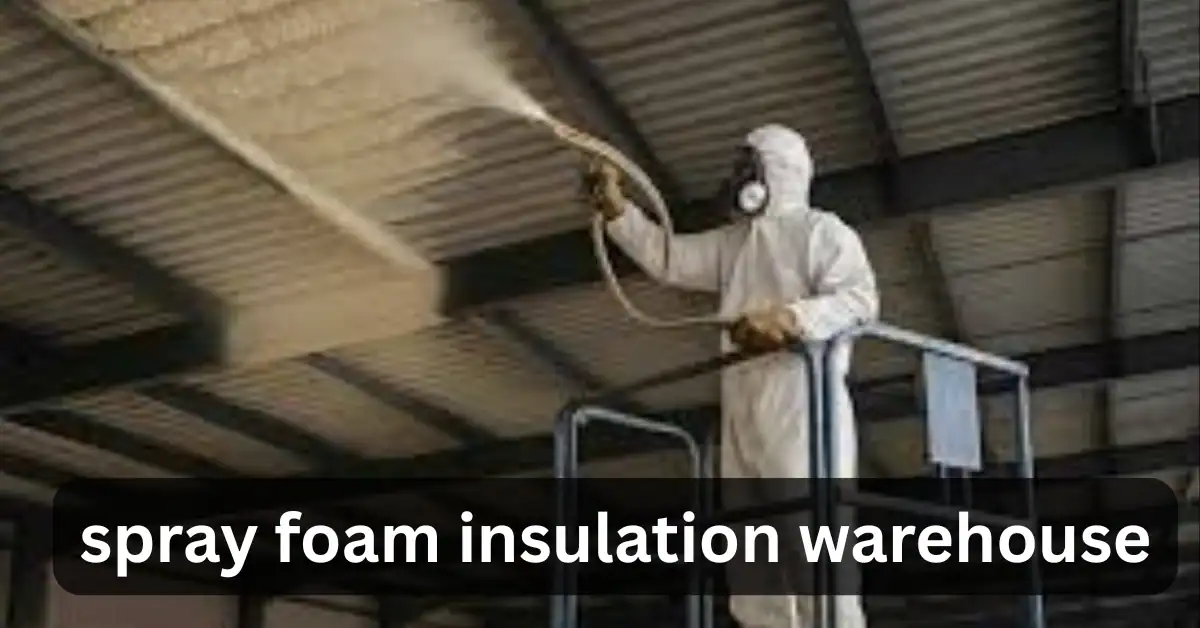
spray foam insulation warehouse can able to increse energy efficiency of your warehouse. In our previous post, we shared more information about the warehouse and warehouse insulation and what value for garage and warehouse wall, You must click here and read the full post. Now, in this post, we shared the information about the spray foam insulation warehouse
Types of Warehouse Insulation: A Comprehensive Guide on Energy-Saving Warehouse Insulation

Many industries rely heavily on warehouses. Maintaining the proper indoor atmosphere is crucial, regardless of whether they keep goods, raw materials, machinery, or equipment. Installing enough insulation is one of the best methods to increase comfort, lower energy expenses, and safeguard inventory.
Insulation is frequently neglected by warehouse owners who prioritise security, lighting, and storage systems. On the other hand, insulation can have a big impact on overall running costs, temperature management, and energy efficiency. Selecting the appropriate warehouse insulation solution helps lower heating and cooling costs while assisting in maintaining consistent interior temperatures all year round.
The most popular types of warehouse insulation, their advantages, and the reasons behind the growing popularity of spray foam insulation warehouse solutions among business owners will all be covered in this book.
The Significance of Warehouse Insulation
Large interior spaces with high ceilings and lots of wall surfaces are common in warehouses. Heat can readily enter in the summer and escape in the winter without enough insulation. This makes HVAC systems work harder, which raises utility costs and makes working conditions uncomfortable.
By lowering heat transmission through walls, roofs, and ceilings, adequate insulation aids in controlling interior temperatures. Additionally, it lessens noise, minimises moisture issues, and shields stored products from temperature changes.
Investing in high-quality insulation is a long-term cost-saving approach for companies that run year-round.
Recognising Various Types of Warehouse Insulation
There is no one-size-fits-all approach to choosing insulation for a warehouse. Depending on the building’s design, budget, and environment, different buildings have varying requirements.
Let’s look at the most popular types of insulation utilised in warehouses today.
Insulation made of fibreglass

One of the most popular insulating materials for commercial and industrial buildings is fibreglass. It is made up of tiny glass fibres that slow down heat transfer and trap air.
There are batts, rolls, and blanket methods for fibreglass insulation. It is frequently installed in roof systems, ceilings, and walls of warehouses.
The cost-effectiveness of fibreglass insulation is one of its main benefits. It is reasonably priced and offers dependable thermal performance. Furthermore, when installed correctly, fibreglass is moisture-resistant and non-combustible
However, fibreglass may become ineffective if it gets wet or squeezed. To guarantee optimal functioning over time, routine inspections are required.
Insulation Using Spray Foam– spray foam insulation warehouse
Applications for spray foam insulation in warehouses are growing in popularity among contemporary insulation technologies. Applied as a liquid, spray foam solidifies as an insulating barrier.
Because of this expansion, the foam may fill in regions that are difficult to reach, gaps, and fissures that conventional insulating materials frequently overlook. An airtight seal that aids in preventing energy loss is the outcome.
Spray foam insulation has a number of benefits.
Outstanding resistance to heat
Capabilities for air sealing
Resistance to moisture
Long life expectancy
Decreased use of energy
Spray foam can be very useful in reducing heat transfer and condensation problems because warehouses frequently have vast roof areas and metal buildings. Because spray foam insulation warehouse systems offer both insulation and air sealing in a single application, many warehouse owners select them.
Insulation for Rigid Foam Boards
Rigid foam boards are solid insulation panels composed of expanded polystyrene, extruded polystyrene, or polyisocyanurate.
These boards are frequently mounted on walls, roofs, and external surfaces because they offer a high insulation value per inch.
Rigid foam boards are very durable and resistant to moisture. They are particularly helpful in warehouses situated in areas with harsh weather.
Rigid foam boards are often used in conjunction with other types of warehouse insulation to optimise performance due to their strength and thermal efficiency.
Insulation Made of Mineral Wool– spray foam insulation warehouse
Natural rock or recovered slag resources are used to make mineral wool insulation. It is renowned for having superior soundproofing and fire resistance.
Mineral wool insulation is frequently useful in warehouses that handle noisy machinery or keep delicate goods.
Apart from its heating capabilities, mineral wool provides:
Resistance to fire
Resistance to moisture
Durability of sound absorption
Many site managers value mineral wool’s long-term performance and safety advantages, despite the fact that it can be more expensive than fibreglass.
Insulation that reflects light
Compared to conventional insulating materials, reflective insulation functions differently. It reflects radiant heat away from the building rather than reducing conductive heat transmission.
In warmer climates where solar heat gain is a significant concern, this kind of insulation works especially well.
In order to cut interior temperatures and cooling expenses, reflective insulation is frequently placed beneath warehouse roofs.
During the summer, reflective insulation can significantly reduce energy consumption in warehouses with metal roofing systems.
How to Pick the Best Insulation for Your Warehouse
Some factors influence the choice of insulation.
Climate is the first factor to take into account. Higher R-value insulation may be necessary for warehouses in colder climates in order to retain heat. In warmer areas, facilities could give priority to spray foam solutions that reduce heat gain or reflective insulation. Building construction is the second factor. Thermal bridging and condensation are common in metal warehouses. By forming a continuous insulating barrier, spray foam insulation warehouse applications successfully handle both problems.
Another crucial factor is the budget. Even though some insulating materials are more expensive initially, they frequently result in larger long-term energy savings.
When comparing various types of warehouse insulation, business managers should also take moisture control, fire safety regulations, and maintenance requirements into account.
Spray Foam Insulation Warehouse Solutions’ Advantages
Spray foam insulation warehouse systems are unique among all the insulation choices on the market today because of their effectiveness and adaptability.
Energy savings is one of the main benefits. By reducing air loss and creating an airtight seal, spray foam improves the efficiency of HVAC systems.
Controlling moisture is another advantage. Condensation is a common problem in warehouses, particularly in metal buildings. Spray foam aids in preventing moisture accumulation, which can cause structural damage and the growth of mould.
By sticking straight to surfaces, spray foam also fortifies building envelopes. The entire performance of the building may be enhanced by this increased durability.
Furthermore, when professionally put, spray foam lasts for decades and requires no upkeep.
Spray foam is a popular option for warehouse owners looking for long-term energy efficiency because of these advantages.
Warehouse Roof Insulation– spray foam insulation warehouse
In a warehouse, the roof is frequently the main source of heat gain and loss. In order to preserve indoor comfort and lower energy consumption, proper roof insulation is essential.
Roof systems can employ a variety of warehouse insulation types, such as spray foam, fibreglass blankets, rigid foam boards, and reflective insulation.
Warehouse roofs with spray foam insulation are especially effective since the material forms a smooth protective barrier and adapts to uneven surfaces.
In addition to preserving stored product, roof insulation can greatly reduce temperature swings, improving worker comfort in warehouses.
Solutions for Wall Insulation
Another significant location for energy loss is the walls of warehouses. In addition to lowering heating and cooling costs, insulating walls can increase temperature stability.
Due to their low cost, fibreglass batts are still a common option for wall insulation. On the other hand, spray foam offers better thermal performance and air sealing.
To increase energy efficiency, rigid foam boards are frequently installed on external walls.
Building design, insulation objectives, and available funds all play a role in selecting the best wall insulation. Moisture Control and Condensation Prevention In warehouses, especially those built with metal panels, condensation is a frequent problem. Moisture can build up and harm cold surfaces when warm air reaches them.
By keeping surface temperatures constant, adequate insulation aids in the control of condensation.
Because spray foam insulation warehouse systems remove air spaces where moisture might accumulate, they are very effective at reducing condensation.
For warehouses holding electronics, food items, medications, and other items that are sensitive to temperature, moisture control is crucial.
Return on Investment and Energy Savings
Energy savings are one of the main motivations for businesses to invest in insulation.
Warehouses with adequate insulation need less heating and cooling all year long. Lower utility costs and less stress on HVAC systems result from this.
The long-term benefits frequently outweigh the greater installation costs associated with various insulating materials. After improving insulation systems, many warehouse owners claim discernible drops in energy costs.
Better insulation can boost property value and prolong the life of building components in addition to directly saving money.
Utilising The Insulation Warehouse
Selecting knowledgeable vendors and contractors is crucial when organising an insulation job. For advice on choosing products and installation techniques, many companies consult the insulation warehouse experts.
The experts at the insulation warehouse can assist in assessing the state of the building, locating locations where energy is lost, and suggesting appropriate insulation solutions. spray foam insulation warehouse
Working with skilled professionals guarantees that insulation systems are properly fitted and provide optimal performance over time. Whether building a new warehouse or renovating an old one, expert advise can have a big impact on the final product.
Typical Errors to Avoid– spray foam insulation warehouse
A common error made by warehouse owners is to prioritise insulating costs over overall effectiveness.
Selecting the least expensive material could result in future energy costs and more frequent maintenance.
Ignoring air leaks is another frequent error. If holes and crevices are left open, even premium insulation may function poorly.
The efficiency of insulation might also be decreased by poor installation. Appropriate coverage and long-term dependability are guaranteed by professional installation.
Finally, because a lot of heat frequently enters or exits through the roof, disregarding roof insulation can drastically lower energy efficiency.
Upcoming Developments in Insulation for Warehouses
Businesses are looking for more effective insulation technology as energy costs continue to rise.
High-performance reflecting systems, environmentally friendly insulating materials, and sophisticated spray foam solutions are all growing in popularity.
Innovation in the insulation sector is also being fuelled by sustainability. These days, a lot of firms sell goods created using ecologically friendly production techniques and recycled materials.
In order to maximise energy use and enhance facility efficiency, smart building technologies are anticipated to collaborate with insulation systems.
By investing in contemporary insulation solutions today, warehouse owners may set up their establishments for long-term sustainability and efficiency.
In conclusion about spray foam insulation warehouse
One of the best investments a company can make is selecting the appropriate warehouse insulation. In addition to protecting inventory and lowering long-term running costs, proper insulation also increases employee comfort and energy efficiency.
Spray foam insulation warehouse systems perform very well among the different forms of warehouse insulation available because of their durability, air-sealing capabilities, and energy-saving advantages. Depending on the needs of the building, fibreglass, mineral wool, rigid foam boards, and reflective insulation are also useful options.
Consulting with professionals at the insulation warehouse or spray foam insulation warehouse may help you choose the best insulation approach, whether you are planning a new construction project or renovating an existing structure. Warehouse owners may benefit from reduced energy costs, improved indoor conditions, and enhanced building performance for years to come by investing in high-quality insulation today.
Do let us know how you feel about this information by commenting.
Like our Facebook page and follow for other updates like this.